
Universal Truths and Cycles

February 13th, 2012 § 2 comments § permalink

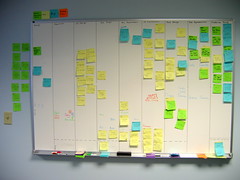
Kanban BoardI came of age in a professional environment that was excessively clunky. Information technology, having had its way with the financial industry, was making its way into the inner workings of all sorts of organizations. The people, however, were still very much accustomed to the thought processes and organizational methods that emerged from the ‘productivity’ thinking of the 1960s and 1970s. The emphasis was very much on strategic planning, rigidly defined bureaucratic specialization, tremendous amounts of documentation and detail, and a privileging of process above all else. It was, from an experiential perspective, slow.

And as often is the case with disruptive technology, it is commonly the set of people who introduce it that are first forced to actually accommodate the new ways of thinking and processing information that said technology necessitates.1 And so, several forward-thinking software people were forced (really) to create the Agile Manifesto. Building software the old way, let along getting people to use it, just did not scale.

Our teams (and my current and many past employers, including myself) make use of Agile methods. I am a believer in these methods. I believe in them because they work better than most. Like any method, they must be adapted to the practitioner’s local context to be effective, and therein lies several cycles of adaptation and experimentation, much of which is usually painful and illuminating.

Lately, I’ve been thinking a lot about how people tend to focus on the post-adaptation and post-experimentation phase of applying methods for dealing with work problems, often to the detriment of the actual problem the method was trying to solve. A wise man pointed me to the concept of orthopraxy, defined in contrast to orthodoxy, as an emphasis on conduct and actual practice as opposed to ritual and accepted belief. I’m probably butchering (or appropriating) these terms when I say that orthopraxy is about doing what works and orthodoxy is about doing what’s commonly accepted as working.

Recently, one of our teams had a Come to Rabbi™ conversation2 about their delivery vs. their clients’ expectations. The outcome of this conversation was a recognition that requirements needed to be better defined. Some of the members of this team come from Agile backgrounds, but many do not. And so the dreaded Waterfall words were uttered: “functional specification.” And the classic texts get distributed: Spolsky on Painless Functional Specifications and Fried on No Functional Spec, and Atwood on Dysfunctional Specifications. The dance begins. What works? What’s commonly accepted as working?

Universal Truths and CyclesGiven a long enough perspective, you can begin to see the same dialectic cycle which produced Agile beginning to generate the need—or at least the desire—for new approaches. This is no startling insight, just common sense and observation. Things which are radical answers to the previous cycle’s orthodoxy inevitably become the new orthodoxy. And that’s where the danger arises. Organizational structures evolve in ways that are at odds with their initial intent. Teams get stuck in patterns of orthodoxy, where the noble intent of their methods are reduced to cargo cultish repetitive behaviors. It’s the opposite of pragmatism.

I have seen this pattern before. It was present when I worked in the world of User Experience, where the orthodoxy of what were once radical design sensibilities came into conflict with the need for new methods presented by digital products. I’m seeing it now, with increased frequency, around words like “design” and “long-term roadmap” and phrases like “what are we really trying to solve for?” when mixed with Agile development.

So the interesting thing here, going back to all the annoying “Old Guy Having Seen It All Before” talk at the beginning, is that these things have a way of working themselves out. Quickly, call out the pattern and come to grips with the cracks in the edifice of orthodoxy. The sooner you focus on what works as opposed to what’s commonly accepted as working, the sooner you come to a better synthesis and move on. Until the next time, when down will go back up, forevermore!3


  1. Back in Graduate School™ we used to call this an epistemic community. []
  2. The astute reader will recall, of course, that the Savior in question was in fact, a Rabbi. []
  3. Thanks, Uncle Bob. []


The Magic of Fake Italian

February 5th, 2012 § 0 comments § permalink

Comedic sublimation serves a pivotal role in human communication. It allows for socially unappetizing or emotionally-challenging messages to be sent and received without triggering some of our most common defense mechanisms. The use of self-parody, self-deprecation, and other forms of emotional sleight-of-hand tends to reduce tension, and allows for difficult but necessary things to be said.

That’s why our team uses Fake Italian.1

Fake Italian came to my attention by way of Mr. Steve Albini, Montana native and Chicago resident. You may know him from the band Shellac, for instance, or his very fine recording studio, Electrical Audio. And less well known, but immensely entertaining and useful, his food blog. His description of Fake Italian comes from the forthcoming and highly anticipated Hargrove House documentary, “Couldn’t You Wait: The Story of Silkworm.”

Fake Italian emerged, in the modern form in which we apply it, out of the experiences shared by Albini, his bandmates, and the members of  Silkworm.2 Touring with Shellac and Silkworm was the Sicillian band Uzeda and its guitarist,  Agostino Tilotta, whose spoken English carried within its measured tones the seeds of communicative nirvana:

The money quote:

Fake Italian is just so much easier on you. It allows you to say things in a way that doesn’t offend anybody if you want to say something that’s critical. It makes mundane things more entertaining to talk about, and it plays with everyone’s sense of the absurd.

It’s been my experience that many people struggle with the ability to provide criticism without incurring shame, embarrassment, or wrath. Vast amounts of time are spent constructing stylized edifices of avoidance, disingenuousness and bald-faced lying. It’s actually much more damaging to someone—especially if you happen to care about them—to neglect providing genuine feedback. Still, saying those kinds of things to people is not always easy. All of this can be avoided with the simple application of Fake Italian.

§§§

Example

Alice: Hi, here’s the model on our performance over the last month. We spent a lot of time putting the initial data together, but we didn’t get a chance to really work through it in much detail. I know you were looking for some specific answers like we talked about. The data’s there, but we couldn’t really answer any of those questions. Sorry.

Bob: Wait. Uh. Um. (sputtering; face reddening)

Carol: (in Fake Italian) Alice, this model. She reminds me of a sandwich, a sandwich full of delicious flavors waiting to satisfy a person with a deep hunger. This sandwich, she was made by a thoughtful deli worker, with love and attention, early in the morning, in a room filled with the smell of freshly baked bread, on a day rich with the promise of satisfaction from a sandwich well-made. Her lettuce was once green, the deep green of the fields at harvest time as the sun peaks in the sky. Her tomatoes, with a rosy hue that shines plumply as they tumble to the counter, full of sweet and subtle flavors. Her meats, carefully carved from the most delicately roasted cuts of tender ham, turkey and the rarest and most delicate beef. Her bread, golden like the afternoon sun, and fluffy like the clouds in the sky. But instead of being served at lunch, when desire and deliciousness could come together in the heart of a famished person, this sandwich, she sat in the deli counter all the day. Nobody paid her attention; nobody saw what she could become for a hungry person. And her lettuce, it wilted. Her tomatoes became soft and chalky. Her meats began to droop and become shiny. Her bread softened into paste. She is no longer a sandwich of love, but a sandwich of…absence.

Alice: (realizing) I…uh…ah…that is…

Bob: I’m feeling a bit peckish, myself.

Carol: In the next month, we will all eat sandwiches…together!

Alice: You got it, Carol. (smiling)

§§§

So there you have it. For most organizations I’ve been in, that conversation would have gone either one of two ways: acrimonious/accusatory or aloof/absent. With Fake Italian in the mix, the right message was sent, without an excess of unnecessary difficulty.

Maestro Albini3 offers wonderful examples on how to incorporate flora and fauna into your Fake Italian in the video above. Our team has found these to be extremely effective, but they are certainly not the only choices available. Just like Fake Italian itself, it has to come from your heart. So if you grew up on a farm, use agricultural constructions. If you study  metallurgy, talk about ores and the Mohs scale. Work in software? Talk about text editors. Some other avenues of potential Fake Italian simile, analogy and metaphor include:

- popular music
- genre motion pictures
- commonly-viewed television programs
- fiction and literature
- bodily processes

One note on delivery. Unlike your more complicated accents for the vocally impression-challenged, even poorly executed Fake Italian is comprehensible. In fact, in certain cases an earnest but hilariously incompetent Fake Italian accent defuses the tension of direct criticism so much so that the actual hard part is over after the first few words.

Try it.


  1. And my friends. And my family, though truth be told, Fake Italian is not as effective on small children, or the less subtle. []
  2. What superlatives can begin to encompass the experience of listening to and loving (yes, loving, unashamedly) Silkworm? It’s the same problem as e.g. the Minutemen. Life-saving, perhaps? []
  3. This label applied with absolutely 100% sincerity. Perfect description. []


Mid-Sized Company Growth, Specialists, Loss of Context and the Television Pilot Conversation from Pulp Fiction

January 26th, 2012 § 0 comments § permalink

When working with specialists, context is everything.

When I ran a startup, I tended to gravitate towards and hire people with a multi-disciplinary focus. I liked hiring people that wrote code but also understood interaction design. I wanted people who liked managing clients but were also obsessed with data. I liked hiring visual designers who understood marketing strategy. Those sorts of generalists are critical in a start-up, because you don’t have the capital or time to develop a wide variety of specialist functions. You pick your single area of focus and make big investments there, but rely on generalists for the non-core functions. I also think that generalists are more comfortable in the dynamic environment a start-up provides.1

When your company gets to be mid-sized, things change. You’re not quite big enough to have full-on specialist functions throughout the organization, but you’re too big to have a team consisting largely of utility players. People who were once all-in-one coders, testers, and project managers start to move up the food chain and get more focused. And in certain areas of the business where the possibility of eking out some competitive advantage exists, specialists begin to accumulate. This is entirely natural, but it has consequences.

As groups of specialists—more accurately, specialist functions—emerge, there is a concomitant loss of context. Groups of people begin to form who just do data analysis, or just do functional testing, or just write RFPs. If you hire correctly, they begin to do these things really well. But because there’s specialization, and because there’s less organic messiness in the way decisions get made, and just because there are more people, there’s a natural predilection towards increasing the efficiency of the individual specialized function. That team of search engine optimization gods look at each other and say, earnestly, “Let’s do this right. And with the best of intentions, the organization as a whole starts to optimize for its constituent parts instead of the complete entity.

I want to reiterate that this is a natural outcome of the growth process in companies. I’ve seen it happen again and again. It’s nobody’s fault. It is, however, everyone’s responsibility to mitigate the problem. And I’m not a big believer in large, overarching organizational methodologies as a panacea. Be simple and tactical, and develop a distributed solution to the problem. So while you can expect some additional writing on the dangers of over-specialization in future posts, I want to offer here one simple, tactical suggestion that anyone, at any level of your organization, can use to defeat the Context-Loss-from-Specialization problem.

When you’re working with someone who has a very specific type of knowledge and experience, you have to provide them with an easy way to unpack their thinking from the (otherwise useful) blinders imposed by their specialization. The best way to do this is a conversation, and the name for the special kind of conversation I’ve found to be the most effective in this situation is a Television Pilot Conversation.

This is a reference to a scene in Quentin Tarantino’s film, Pulp Fiction. Check it out:

The Television Pilot Conversation has two purposes, one relatively straightforward, and the other constituted by an ulterior motive. The straightforward purpose is to clearly and succinctly describe the context for the person lacking context. The more sneaky and sub-textual purpose is to remind that person that there are actual other humans out there operating with completely different sets of considerations, familiar with entire bodies of knowledge and experience, possessing skills equally as important or impressive as theirs, that should be taken into account. Now.

Television Pilot Conversations may take place on a one-to-one basis, or in large groups. The more deadpan the delivery (Samuel L. Jackson being the ideal to strive for here), the better. The more use of humor or irony, the better. The more familiar the person on the receiving end is with this particular scene in Pulp Fiction, the better. Here’s a convenient short URL for your distribution pleasure:

http://bit.ly/tvpilot  

The beauty of the Television Pilot Conversation is that anyone in the organization can deliver it to anyone else. It knows no bureaucratic strictures. It transcends seniority, hierarchy, and age. It requires no internal branding campaign, no corporate communications, no brown bag session, no long, boring meeting. It’s context in its most concentrated form, with a format guaranteed to generate results.

Enjoy.


  1. Frankly, I just plain like being around people who mix their chocolate and peanut-butter. Amongst even the most highly specialized people, an intense second interest—cf. correlation between superb software engineers that are also talented musicians—is often a good indicator of robust capabilities elsewhere. []


EduLender Launches

August 2nd, 2010 § 0 comments § permalink

One of the Excelerate Labs companies I have the honor of mentoring, EduLender, has officially launched its service. EduLender is a student loan marketplace, sort of like what Kayak.com is to travel—but for student loans.

Congratulations to Sue Khim and Sam Solomon and their whole team.

The 1st Annual Leapfrog Online Pinewood Derby

May 23rd, 2010 § 0 comments § permalink


Leapfrog Derby Entrants, originally uploaded by The Hitmaker.

Part of the ground rules we establish when people join the team at Leapfrog Online is the notion of Fun. We take our work seriously, but ourselves, not so much. Part of the execution involves what we describe as Antics.

While there was a brief but intense flirtation with networked FPS games during the winter doldrums, by far the best single set of Antics for 2010 has been the Leapfrog Derby, a Pinewood Derby with a Cub Scouts™ official track and some serious engineering effort.

There were those who were working through past childhood issues around over-zealous and under-involved parents, those who just like building things, and those who were just in it for the glory.

A great time was had by all.

Ask UXMatters

April 19th, 2010 § 0 comments § permalink

The good folks over at UXMatters have been kind enough to solicit my opinion on User Experience topics for their “Ask UXMatters” regular feature.

This week’s episode made worlds collide: my former life in the world of UX and digital product design and development and my current one in digital direct marketing. Actually, they overlap every day, but it’s subtle in the operational role I play at Leapfrog Online. Mostly.

This week’s piece is about form dropouts and the use of testing. There was another one not too long ago about building a centralized, enterprise-wide UX group in your organization, a topic near and dear to my heart.

And for those interested in ancient history, there’s a long thought piece I did for UXMatters back in 2006 about designing for bridge user experiences.

A bridge experience is one in which the user experience spans multiple communications channels, document genres, or media formats for a specific, tactical purpose. These sorts of bridge experiences, within the context of less abrasive digital marketing, constitute a significant portion of my work and the work of my team today.

Excelerate Labs and ScaleWell: New Chicago Incubators

April 18th, 2010 § 1 comment § permalink

Chicago has always been less than stellar in self-promotion when it comes to our entrepreneurial community. It’s not like there’s a lack of capital, nor a lack of talent. There’s a ton of opportunity, and there’s a ton of great work going on here. It’s not nearly as networked as it should be, and it’s often under-reported. That seems to be changing with the introduction of two new seed capital incubators, Excelerate Labs and ScaleWell.

See coverage of Excelerate Labs in TechCrunch, and coverage of both Excelerate and ScaleWell in Crain’s Chicago Business.

Excelerate Labs is an entrepreneurial incubator program, similar to TechStars, which offers seed capital (in the low five figures) and mentorship to new startups. It’s well-connected to some of Chicago’s leading entrepreneurs and venture capitalists. ScaleWell, the brainchild of Sean Corbett (HaveMyShift.com) and Andy Angelos (GetTalkedAbout.com) is a much more organic and grassroots effort, offering $1,000 and office space. Both occupy a much needed space in the Chicago entrepreneurial community, alongside the more established organizations like the Chicagoland Entrepreneurial Center.

I’m honored to add my support to Excelerate Labs as a mentor for the Summer 2010 session.

Word from Troy Henikoff is that the participants will be announced very soon, and I’m extremely excited to meet and begin working with them.

I’ve also reached out to Sean Corbett of ScaleWell to see about helping there as well.

It’s good to give back.

Leapfrog Online Profiled in Chicago Tribune

February 1st, 2010 § 0 comments § permalink

From the February 1, 2010 Chicago Tribune:

Culligan turned to Leapfrog Online for help about a year ago because it liked its quantitative approach. “Finding our target consumer can be difficult,” Rosenthal said.

Leapfrog creates Web pages with specific promotional offers, tracks results and handles search engine keyword buys.

“They report back weekly on, ‘Here’s where we are having success and here’s where we’re not,’ ” Rosenthal said.

The relationship works best through collaboration. Clients must trust Leapfrog Online with their brands because the agency works as a mini-marketing department for them.

Full Article: http://www.chicagotribune.com/business/ct-biz-0201-mon-minding-leapfrog–20100129,0,3879233.column

Initiating Name Change

March 26th, 2009 § 0 comments § permalink

It appears that I may have more to say at some point, so making some visual and verbal preparations. Minor facelift, and new title, intended to describe the goal I often find myself driving towards these days. That goal is helping people get to the point where they can see the solution to a particular problem as requiring little further effort and consideration, and merely a series of well-understood steps. Hence: relatively trivial exercise.

$30 Million

September 9th, 2008 § 0 comments § permalink

Leapfrog Online has raised a $30MM equity investment from North Bridge Growth Equity, a $545MM growth equity fund located in Waltham, Massachusetts.

Media Coverage in Crain’s Chicago Business and on PR Newswire.

Well worth the effort and very exciting.